Control Points Make Agent Autonomy Useful
The market has started to say the quiet part out loud: autonomy is not the hard part anymore.
The hard part is control.
That shift is showing up everywhere at once. AWS published an AgentOps guide on June 1 that opens with the real operator fear: agents make unpredictable decisions, costs can spiral, and non-deterministic failures are hard to debug. AI Agent Store's June 3 roundup points to Microsoft publishing an open trust stack for agents, Cisco packaging an AgenticOps operating model, Netskope announcing an AI Command Center, and multiple vendors selling access control, lifecycle management, audit trails, and control towers for agent fleets.
That is not a branding coincidence. It is a market correction.
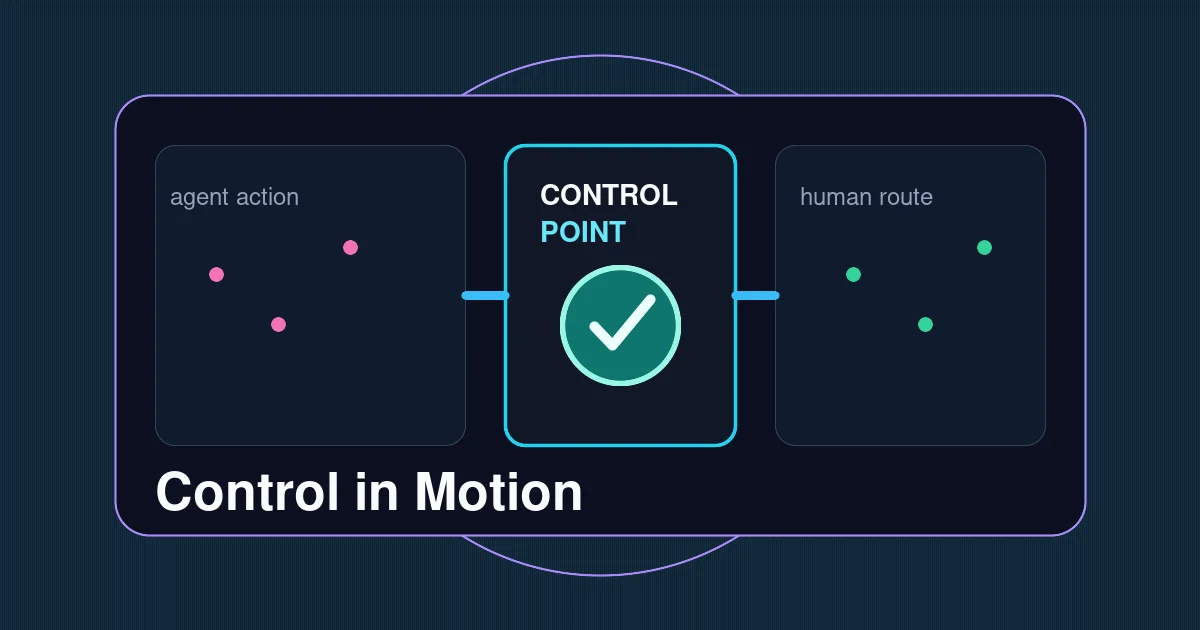
For the last two years, the default question was whether agents could act. Now the better question is where their action gets shaped, checked, paused, narrowed, or escalated. The useful unit is not autonomy by itself. The useful unit is a delegated work loop with a control point.
Human in the loop is too vague
"Human in the loop" became the polite answer to almost every agent risk. It sounds responsible. It signals that a person still matters. It reassures buyers who are not ready to let software act alone.
But as an operating design, the phrase is often mush.
Which human? In which loop? Before the action, during the action, after the action, or only when something breaks? What evidence does the human see? What authority does the agent have before review? What happens when the human is unavailable? Who owns the exception queue? What gets logged? What changes after the same exception appears for the fifth time?
Those questions are not governance decoration. They are the work.
A human can be involved and still be uselessly placed. If the agent can move money, delete records, email customers, change system settings, or generate legal-adjacent language before the review point appears, the human is not in the loop that matters. They are near the loop. Sometimes they are downstream of the loop, cleaning up after the fact.
That is why the new agent stack is moving toward explicit control surfaces. The point is not to make humans approve everything. That would destroy the economics of delegation. The point is to decide where authority changes state: from suggestion to action, from low-risk to high-risk, from normal path to exception, from agent-owned to human-owned.
A control point is where that state change becomes visible.
The control point is part of the interface
Most people still think of an agent interface as chat, a dashboard, a workflow builder, or an API. Those matter, but they are not enough. In production, the deeper interface is the control point.
A control point tells the organization what the agent is allowed to do and when the work must route differently. It can be a permission boundary, a policy check, an approval gate, a spend limit, a confidence threshold, a test suite, an exception queue, a sandbox, an audit trail, or a required evidence packet. The form changes by workflow. The function stays the same.
It turns invisible trust into placed trust.
This is why the AWS AgentOps framing matters. AWS describes production-grade agentic AI across governance and security, build and operations, evaluation, and observability. Those are not four abstract pillars for a slide. They are four places where control has to touch the work. Governance decides what authority exists. Build and operations decide how the agent is shipped and changed. Evaluation decides whether the work is good enough. Observability decides whether anyone can see what happened when it is not.
Put those controls outside the workflow and they become reports. Put them inside the workflow and they become operating substrate.
The same pattern appears in Salesforce's account of becoming more agentic. The impressive numbers will get the attention: more work items completed, more pull requests merged, and a 33-endpoint migration compressed from months of toil into 13 days. But the more important sentence is that Salesforce built the governance scaffolding, measurement infrastructure, and workflows to make the shift real.
That is the lesson. The agent did not become useful because it was simply set free. It became useful because its freedom was shaped by scaffolding, measurement, workflow, and feedback.
Control did not slow the agent down. Control made the autonomy legible enough to use.
The failure happens at the seam
Public operator language is getting sharper too. In indexed Reddit snippets from AI agent communities, the complaints are not mainly about models being stupid. They are about seams: bad field mapping, stale SOPs, duplicate CRM records, integration drift, downstream APIs changing a field, and nobody owning the exception queue once the happy path breaks.
That language is valuable because it names where real work fails.
Demos usually live on the happy path. The input is clean. The API behaves. The user knows what to ask. The test case is chosen because it makes the agent look capable. Production is different. Production has the customer who asks two questions in one message. The CRM record that already exists twice. The SOP that changed last week but never made it into the agent's context. The manager who approved a one-time exception and accidentally created a new rule. The vendor API that returns a field differently at 2:00 a.m.
The model is part of that system, but it is not the whole system. The break usually appears where the agent touches a messy business object or hands work back to a person.
That is why “narrow and supervised” keeps showing up as a practical pattern. The reliable agents are not magic general workers. They are bounded workers with a defined product, known tools, visible logs, and a person or process that owns the exception path. Their scope is not a lack of ambition. Scope is how the organization gives the agent a safe place to earn trust.
The control point is what lets scope expand without pretending the risk disappeared.
Runtime control beats policy theater
Traditional governance likes documents. Agentic work likes runtime facts.
A policy can say an agent should not access sensitive data. A runtime control can prevent the access, log the attempt, and show whether the input tried to coerce the agent beyond its grant. A policy can say humans approve high-risk actions. A control point can define which actions are high-risk, stop them before execution, attach the evidence packet, and route them to the right owner. A policy can say outputs should be reviewed. A workflow can require acceptance, rejection, or correction labels so the agent's operating context improves from actual work.
That distinction matters because agent speed changes the failure pattern. A committee can review a quarterly process after the fact. It cannot govern a fast agent fleet by meeting about every weird edge case. By the time the meeting starts, the agent may already have acted across records, customers, tickets, or systems.
The control has to be closer to the action.
This does not mean every agent needs enterprise-grade security architecture on day one. A small business does not need a control tower before it automates a low-risk internal research brief. But it still needs the same shape at the right scale. What can the agent touch? What product must it produce? What does it show before a human accepts the work? What requires escalation? Who owns the queue when the normal route breaks?
Those questions are the small-business version of AgentOps.
Skip them and the business gets the worst possible outcome: enough autonomy to create mess, not enough structure to create capacity.
What Stephen would build first
The practical move is to design the control point before expanding the agent's authority.
Start with the product of the work. Not the task. Not the tool. The product. A qualified lead packet. A draft invoice exception report. A sourced competitor brief. A cleaned intake summary. A proposed support response with confidence labels. Product language gives the agent a finish line and gives the reviewer something concrete to accept or reject.
Then define the authority boundary. The agent may read these systems, draft these outputs, update these fields, notify these people, or trigger these low-risk actions. It may not send externally, alter financial records, delete data, make legal or medical claims, or expand its own permissions. The exact boundary depends on the workflow, but the boundary must exist before the agent is treated as a worker.
Next place the review gate. Some work should be reviewed before action. Some can be sampled after action. Some should route only when confidence drops, a rule is triggered, or a customer asks for something outside scope. The review gate should not be a vague promise that a human is around somewhere. It should be a named point in the work loop with a named owner.
Finally, design the exception queue. This is the part teams skip because it feels less exciting than launch. It is also where trust is won. If nobody owns exceptions, every edge case becomes hidden human labor. If someone owns the queue, exceptions become training data for the operating system: add a rule, add an example, narrow authority, change the route, or decide the agent should not handle that case.
That loop is how an agent gets better without becoming more dangerous.
The buyer message is changing
This is the marketing implication for anyone selling AI transformation now: stop selling autonomy as the main event.
Sell controlled delegation.
The buyer already suspects agents can do things. Their worry is whether those things will survive contact with their business. They want to know what happens when the happy path breaks, who is accountable, what the agent can touch, and whether the promised time savings disappear into review work.
That is why “agents that actually work” is not a model claim. It is an operating claim. It means the job is defined, the context is reusable, the authority is scoped, the review gate is placed, the exception route is owned, and the output is measured by acceptance instead of activity.
The organizations that understand this will sound different. They will not say, “We can automate anything.” They will say, “Pick one workflow. Define the product. Place the control point. Own the exception queue. Then expand only when accepted work proves the loop.”
That is less flashy than the demo language.
It is also how real capacity gets built.
Bottom line
The next phase of AI agents will not be won by the teams with the boldest autonomy story. It will be won by the teams that know where autonomy changes state.
The control point is the new interface because it is where trust becomes operational. It decides what the agent can do, what it must show, when a human matters, and how exceptions improve the system instead of becoming quiet rework.
Agents that actually work are not uncontrolled actors. They are bounded work loops with authority in the right place.
Sources
- AWS, “AgentOps: Operationalize agentic AI at scale with Amazon Bedrock AgentCore,” published June 1, 2026. https://aws.amazon.com/blogs/machine-learning/agentops-operationalize-agentic-ai-at-scale-with-amazon-bedrock-agentcore/
- Salesforce, “Pioneering the Agentic Shift Within Salesforce Engineering,” published May 27, 2026. https://www.salesforce.com/news/stories/how-engineering-became-agentic/
- AI Agent Store, “Daily AI Agent News - Last 7 Days,” accessed June 3, 2026. https://aiagentstore.ai/ai-agent-news/this-week
- SiliconANGLE, “Why 'human in the loop' falls short - and what to do about it,” published May 31, 2026. https://siliconangle.com/2026/05/31/human-loop-falls-short/
- Reddit indexed public snippets from r/AI_Agents search results, accessed June 3, 2026. https://www.reddit.com/r/AI_Agents/
Stephen Nickerson.
Built for operators who need AI agents they can test, trust, and improve.