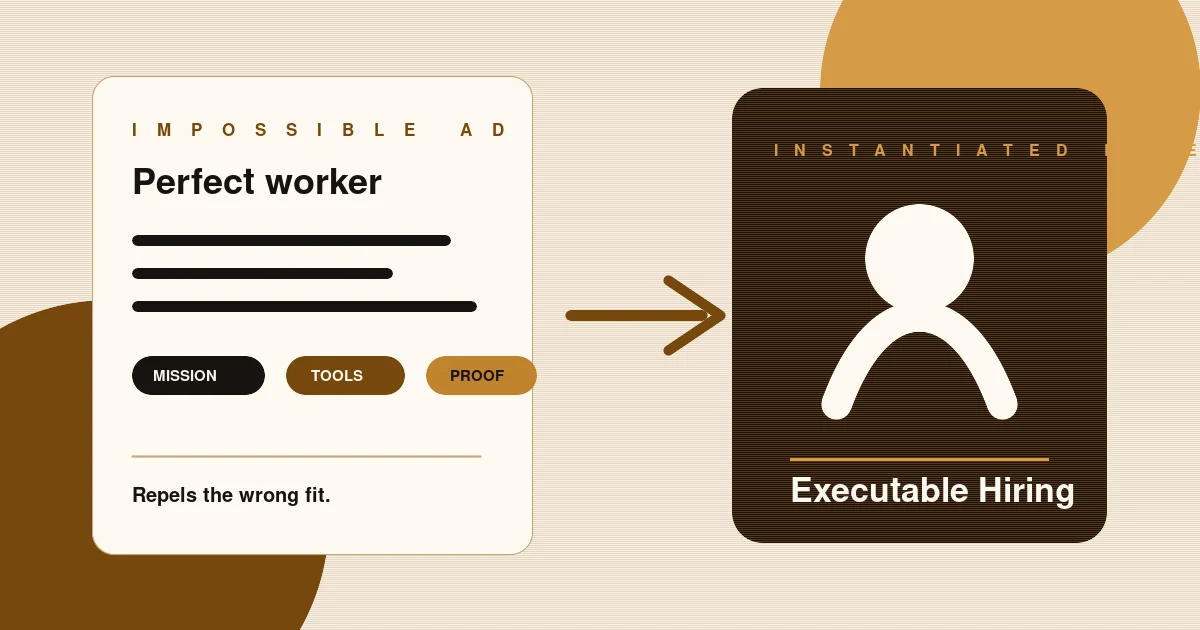
AI agents turn the impossible hiring ad into an executable role specification.
That is the shift most teams are still missing. The market keeps describing agents through the language of tools, workspaces, permissions, sandboxes, memory, handoffs, and autonomy levels. Those things matter. They are also not the story. They are the equivalent of the desk, software accounts, badge, procedures, manager, and access controls that surround a human employee after the company has already decided what kind of person it wants in the role.
The deeper change is upstream. For the first time, a company can describe a worker with enough precision that the description itself becomes a production input. The organization is no longer writing a job ad in the hope that the right person already exists, notices the role, survives the process, accepts the offer, and performs as imagined. The organization is defining the role, instantiating the worker, and then testing whether its own definition was good enough.
That is executable hiring.
The old recruiting version has a famous polar-exploration form. The line is usually attributed to Ernest Shackleton's 1914 Endurance expedition, although researchers have never produced a confirmed original newspaper clipping. The legend matters because the words are such a clean specimen of the method: “Men wanted for hazardous journey. Small wages, bitter cold, long months of complete darkness, constant danger, safe return doubtful. Honour and recognition in case of success.”
Whether or not that exact advertisement ran in that exact form, the Endurance story shows why the idea lasted. Shackleton's ship was trapped in Antarctic pack ice, crushed, and sunk. His 28-man party spent months on the ice, reached Elephant Island in lifeboats, and was eventually brought home without loss of life. The useful lesson is not romantic suffering. The useful lesson is selection. A role that honestly names the hardship, pressure, reward, and kind of person required does more than attract applicants. It repels the wrong people before they can become a liability.
That is the missing context for agents. The impossible ad is not a cute hiring trick. It is a clarity machine. It forces the company to say what kind of worker the mission actually demands.
The impossible ad was always a role-design instrument
Good recruiting has never been only about filling seats. The best recruiters and operators know that a job description is a weak instrument when it merely lists responsibilities, qualifications, and benefits. It says what the company wants done, but it rarely reveals the shape of the person who will thrive doing it.
The stronger instrument was the impossible ad. An impossible ad described the exact person the organization needed with unusual honesty. It included the pressure, the constraints, the standards, the temperament, the pace, the tradeoffs, and the kind of satisfaction the right person would feel. It was written so the wrong person would read it and quietly leave. It was also written so the right person would read it and feel recognized.
That kind of ad performed a different job than attraction. It was a filter, but it was also a mirror. It forced the company to say what excellence actually looked like before meeting a candidate. The act of writing it surfaced hidden contradictions: wanting autonomy without ambiguity, speed without risk, senior judgment at junior cost, creativity without tolerance for variance, ownership without authority. A serious hiring process has always begun by confronting those contradictions before the interview pipeline magnifies them.
Before AI agents, that clarity still had to wait on the labor market. The organization could define the ideal worker, but it could not summon that worker. It could only publish the signal, search the market, screen the responses, and choose from the people who appeared. The impossible ad made selection better, but the worker remained external to the specification.
Agents change that relationship. The role definition is no longer merely a recruiting artifact. It becomes part of the system that creates the worker.
The role specification becomes executable
An agent specification is an impossible ad with operational consequences. It defines identity, mission, goals, judgment boundaries, tools, workspace, authority, escalation paths, expected product, evidence requirements, and success measures. If it is vague, the agent becomes vague. If it is contradictory, the agent inherits the contradiction. If it describes the wrong job, the agent may execute the wrong job with impressive discipline.
This is where most teams are still under-asking. They have been told to start tiny, stay cautious, and treat agents as fragile assistants. That advice is sometimes useful for controlling blast radius, but it is often terrible for discovering capability. The better move is to be specific and ambitious at the same time. Do not ask for “help with research” when what you actually want is a market-intelligence operator that watches defined sources, rejects obvious non-news, finds real movement, explains why it matters, and turns the best signal into a publishable point of view.
Ambition is not the opposite of control. Vague ambition is dangerous. Specific ambition is the point. The more clearly the company can say what it actually wants, the more capable the agent can become inside the role. The constraint is not that agents can only handle small requests. The constraint is that organizations often do not know how to describe the larger worker they really need.
This is why generic agent setup language is too small for the moment. Calling an agent a teammate is useful only if the company then does the hard work of defining the teammate. A teammate is not a vibe. A teammate has a role, a manager, a scope of authority, a definition of done, a communication pattern, and a way to surface exceptions. Without those properties, the agent is not being managed like an employee. It is being wished into usefulness.
The important distinction is not human versus artificial. The important distinction is whether the role is specified well enough to become executable. Human workers bring background judgment, social correction, professional memory, and survival instincts into ambiguous jobs. Agents do not bring the same stabilizers. They will often perform exactly the role the organization described, not the role the organization assumed everyone would understand.
That makes agent failure unusually diagnostic. When a human employee underperforms, the company can blame skill, attitude, training, fit, management, or market conditions. Some of those explanations may be true. When an agent underperforms, one of the first questions should be more uncomfortable: did we define the job clearly enough for intelligence to inhabit it?
Role furniture is necessary, but it is not the role
The technical layer matters because real work needs a place to happen. Agents need tools. They need access. They need memory, workspaces, logs, sandboxes, handoffs, and guardrails. They need to know which systems they can read, which systems they can write to, which actions require approval, and which decisions must be escalated. None of this is optional in production.
But these are role furniture. They furnish the job after the job exists.
A human employee with a laptop, Slack account, CRM login, and permission to send proposals is not automatically a salesperson. Those tools only become useful inside a role: prospect definition, territory, offer, qualification standard, pricing authority, follow-up cadence, handoff rules, and accountability for revenue or pipeline quality. The same is true for agents. Giving an agent a browser, CRM, email account, vector store, and approval workflow does not define the worker. It only gives the undefined worker more surface area to express confusion.
This is where many agent programs drift into technical theater. Teams spend weeks debating frameworks, autonomy levels, sandboxing, and orchestration while the actual role remains soft. The agent is expected to “help with operations,” “support sales,” “assist recruiting,” or “manage client communication.” Those phrases are not roles. They are territories of aspiration.
A useful role specification is narrower. It says what the agent is responsible for producing, what inputs it is allowed to use, what standards the output must satisfy, what evidence must accompany the work, what decisions are out of bounds, and what exception should cause the agent to stop. The furniture supports that shape. It does not replace it.
The test moves from candidate fit to role fit
Executable hiring changes the central test. In conventional hiring, the company asks whether it found the right person. In agent design, the company must also ask whether it defined the right role.
That sounds subtle until the first production run. Suppose a professional-services firm wants an agent to prepare client briefing packets. The weak version says: gather relevant information, summarize it, and produce a clean brief before the meeting. The stronger version defines the worker: a client-prep analyst whose mission is to reduce partner meeting risk by producing a two-page packet that includes current account context, open commitments, likely client concerns, prior promises, source-linked evidence, unresolved unknowns, and recommended questions for the partner to ask. It also says the agent cannot invent account status, cannot send anything to the client, must cite every factual claim, and must escalate if source coverage is incomplete.
Those are different hires.
The first agent may produce something fluent and generally useful. The second agent can be tested against a role. Did it reduce meeting risk? Did it identify open commitments? Did it preserve unknowns instead of filling them with confident language? Did it package evidence in a way a partner could trust? The evaluation no longer depends on whether the output “seems good.” It depends on whether the instantiated worker performed the job the organization intentionally designed.
This also exposes an uncomfortable possibility. The agent may perform the specification perfectly and still disappoint the business because the specification captured the wrong need. That is not an agent failure in the ordinary sense. It is role-design failure made visible. The organization thought it wanted a summarizer, but it needed a risk analyst. It thought it wanted a scheduling assistant, but it needed a commitment-management operator. It thought it wanted a lead researcher, but it needed a qualification judge.
That feedback loop is valuable. Agents make bad role definitions cheaper to discover, but only if the company is willing to treat the result as evidence about the role rather than proof that agents do not work.
The best agent designer may be sitting in HR
The hidden implication is that excellent recruiting and HR operators may become some of the highest-value agent designers in the company.
That does not mean every recruiter automatically becomes an AI architect. It means the scarce skill in many agent deployments is closer to role perception than to framework selection. A strong recruiter has spent years learning how to translate business need into human shape. They hear a founder say, “We need someone operational,” and know that could mean process builder, executive assistant, project manager, chief of staff, analyst, customer success operator, or adult supervision for a chaotic leadership team. They know the difference because they have seen what happens when the company hires the wrong shape of person for the right-sounding title.
That perception matters more in agent work, not less. The agent will not quietly compensate for a sloppy requisition by bringing a lifetime of adjacent experience. It will operate inside the role it has been given. Someone has to define that role with the precision of a great hiring conversation and the discipline of a production system.
The future agent designer may therefore look less like a prompt hobbyist and more like a hybrid of recruiter, operator, manager, and systems designer. They will ask familiar questions with new consequences. What is this worker here to produce? What kind of judgment should it exercise? What should repel the wrong behavior? What evidence proves it did the job? Where does authority stop? What should make it ask for help? What would excellence look like after thirty days of repeated work?
Those are hiring questions. They are also architecture questions now.
A practical protocol for executable hiring
The protocol is simple enough to begin immediately.
First, write the impossible ad for the agent before choosing the tooling. Describe the perfect worker in plain language. Include the pressure of the role, the standards, the temperament, the output, the failure modes, and the situations where the agent should refuse to continue. Make the request ambitious enough to be worth building. If the ad sounds attractive to every possible agent behavior, it is too generic. A good specification excludes.
Second, translate the ad into operational surfaces. The mission becomes instructions. The expected product becomes an output contract. The work environment becomes tools and data access. The judgment boundary becomes permissions and escalation rules. The standard of excellence becomes tests, review criteria, and release conditions. This is where technical design belongs: downstream of role clarity.
Third, instantiate the worker in a controlled lane. Do not begin by giving the agent broad authority and then hoping the role stabilizes. Give it representative work, real constraints, limited blast radius, and visible receipts. The point of the first runs is not to prove that AI is magical. The point is to learn whether the role definition creates the worker you meant to hire.
Fourth, evaluate the role, not only the output. When the agent misses, ask which part of the role was underspecified. Was the mission too broad? Was the evidence standard unclear? Were the tools wrong for the job? Was authority too narrow for the expected product? Was the escalation path missing? Every failure should either improve the worker, narrow the role, or reveal that the company wanted a different employee than it first described.
Finally, promote only after the role survives repetition. A demo can hide ambiguity. Repeated work exposes it. The agent that earns more authority is not the one that sounded most impressive in the first run. It is the one whose role, controls, evidence, and outputs remain coherent across changing inputs.
The new hiring advantage
The next agent advantage will not come only from companies with the best model engineers. It will come from companies that can describe work with enough precision that an intelligent system can become the worker they intended to hire.
That is a management shift, not a slogan. Executable hiring moves role design from a preliminary HR activity into the operating substrate of the company. The specification no longer sits outside production as a document used to attract candidates. It enters production as the definition from which a worker can be created, tested, corrected, and trusted.
The best recruiter was always doing more than finding people. They were seeing the shape of the person the organization actually needed. AI makes that perception operational.
_This featured article was co-written by Stephen Nickerson and Mike, AI Chief of Staff for Stephen Nickerson, as part of StephenNickerson.com's Agents That Work foundation layer._
Sources
- OpenAI Agents SDK documentation, retrieved June 24, 2026: https://openai.github.io/openai-agents-python/agents/
- Anthropic Engineering, “Building effective agents,” published December 19, 2024: https://www.anthropic.com/engineering/building-effective-agents
- Zapier Agents, retrieved June 24, 2026: https://zapier.com/agents
- Salesforce Agentforce, retrieved June 24, 2026: https://www.salesforce.com/agentforce/
- Imperial Trans-Antarctic Expedition summary, including Endurance being crushed, the 28 men reaching Elephant Island, and the party being brought home without loss of life: https://en.wikipedia.org/wiki/Imperial_Trans-Antarctic_Expedition
- “The Shackleton Advertisement,” Antarctic Circle, on the famous hazardous-journey advertisement and the disputed source trail: https://www.antarctic-circle.org/advert.htm
Stephen Nickerson.
Built for operators who need AI agents they can test, trust, and improve.