Continuity Is the Reliability Layer Agents Were Missing
The user experience of AI reliability is not intelligence. It is continuity.
A user does not experience an agent as a model, a protocol, a server, a token, or a permission grant. A user experiences one thing: can the agent keep doing the work it was trusted to do? If the answer changes from yes to no without warning, the system feels broken even when every individual component is behaving exactly as designed.
That is the quiet failure mode hiding underneath a lot of agent work. The model may still be capable. The workflow may still be correct. The tool may still exist. But the connection between the agent and the outside world has died. From the user's side, there is no meaningful difference between a stupid agent and a disconnected one. Both fail at the moment of trust.
The industry tends to diagnose this as a monitoring problem. Add alerts. Watch each integration. Retry failed calls. Tell the engineer when a token expires. Those steps help, but they do not name the actual mechanism.
The problem is distributed responsibility without shared liveness.
When every tool, server, connector, or agent owns its own survival, reliability becomes a geometry problem. Each part may be reasonable in isolation. Together, they create a system where one expired credential, one missed refresh, one stale grant, or one silent auth failure makes the whole experience feel unreliable. The user does not see the geometry. They only feel the break.
MCP makes the continuity problem visible
Model Context Protocol is pushing this issue into the open because it gives agents a standard way to reach tools and data. That is exactly why it matters. Agents become useful when they leave the chat box and touch the systems where work already lives: files, calendars, code, CRM, Slack, email, tickets, documents, databases, and internal services.
The MCP authorization specification now treats protected MCP servers as OAuth resource servers and defines how clients discover the authorization server and request access. Auth0's June 2025 write-up on the MCP spec update framed the change plainly: MCP servers are being classified as OAuth resource servers, resource indicators help prevent token misuse, and clearer security guidance is needed as MCP adoption grows.
That is useful progress. It makes the access path more explicit. It also reveals the next layer of the problem.
Once agents depend on OAuth-protected resources, the agent fleet inherits OAuth's lifecycle. Access tokens expire. Refresh tokens rotate. Scopes change. User grants are revoked. Authorization servers impose different policies. Resource servers challenge clients differently. The connection is no longer a static configuration detail. It is a living object.
OAuth's own security guidance reflects this. RFC 9700, published in January 2025 as the Best Current Practice for OAuth 2.0 Security, updates the old OAuth threat model for broader, more dynamic deployments and puts serious attention on access-token leakage, audience restriction, sender-constrained tokens, and refresh-token protection. The point is not that OAuth is fragile. The point is that OAuth is alive. It is designed around limited authority, expiring credentials, and controlled renewal.
That design is good security. It becomes bad user experience when agent systems do not build a continuity layer around it.
The common fix is too local
The naive architecture gives each MCP server, connector, or agent its own credential lifecycle. A server stores a token. A local process refreshes it. A local error log records failure. A local alert may or may not fire. The pattern feels simple because every component is responsible for itself.
That simplicity is false.
The number of moving parts grows with the number of consumers. Ten servers means ten places to reason about survival. A hundred servers means a hundred lifecycles, a hundred silent failure surfaces, and a hundred chances that one service goes dark while everyone else appears healthy. Monitoring each part independently does not remove the problem. It decorates the problem with dashboards.
The deeper correction is to stop distributing the responsibility.
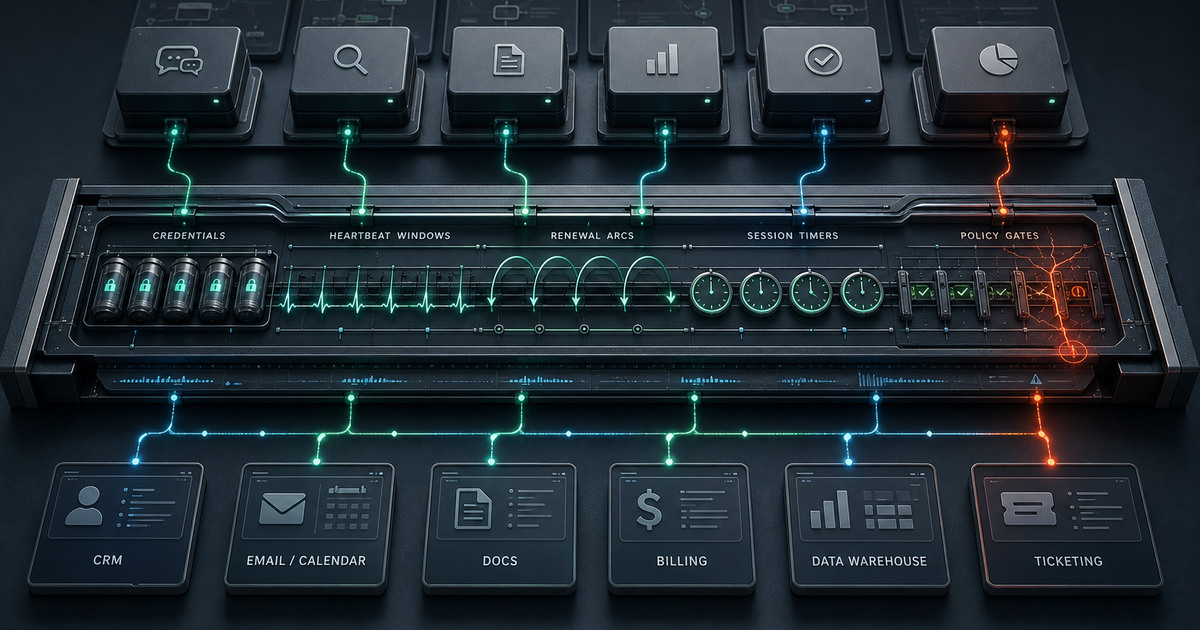
Credentials should not live as private survival objects scattered across the fleet. They should live in a shared liveness layer. Consumers read. The liveness layer maintains. The agent should not own the credential any more than a lamp owns the electrical grid. It draws power from a managed substrate.
That is the architectural pattern worth naming: centralized liveness, distributed use.
The Always-On Authentication Lattice
An always-on authentication lattice is a reliability pattern for agent systems that need continuity more than they need local ownership.
The rule is simple. Credentials live in one managed place. Every authorized consumer reads from that place. The store refreshes proactively. Failure happens early, loudly, and with enough time for a human or system to intervene before the user feels the outage.
That last sentence is the pattern.
Do not wait for expiry. Refresh at the midpoint of the credential's useful life. If the refresh succeeds, every consumer sees the new credential on the next read. No restart. No redeployment. No per-server ceremony. If the refresh fails, the system does not fail silently and hope the next call works. It alerts while the old credential still has life remaining.
The halfway point is not arbitrary caution. It is an engineered resolution window. The system creates time between internal failure and external damage. That gap is where reliability lives.
This is why the pattern is different from ordinary monitoring. Monitoring notices that something happened. Liveness architecture changes when failure becomes visible. In a well-designed system, the engineer learns about the refresh failure while the user is still connected. The alert is not an outage report. It is a prevention event.
Fleet size then stops being the governing variable. Adding more agents or MCP servers adds readers. It does not add independent credential lifecycles. Complexity follows the number of distinct grants, not the number of consumers. That is the recursive scaling move.
Similar to blockchain, but almost the opposite
The blockchain analogy is useful only if it is handled carefully.
Blockchain scales a trust pattern by distributing state agreement across many participants. Each participant does not need to understand the whole system. The protocol gives the network a way to maintain shared truth without trusting a central actor.
The authentication lattice also scales recursively because each participant does not need to understand the whole system. An MCP server does not need to know when a user reauthorized, when a refresh token rotated, or which provider policy changed. It only needs to read the current usable credential from the liveness layer.
But the goal is completely different.
Blockchain distributes trust to avoid central authority. The authentication lattice centralizes credential state to avoid distributed survival. It is not trustless consensus. It is frictionless continuity. The system does not ask every node to agree on truth. It asks every consumer to stop pretending it should manage its own oxygen supply.
That is the useful distinction. The recursive property is similar. The operating philosophy is not.
User identity changes the design
System-level credentials are the easy version. A service account or application grant can live in the lattice, refresh automatically, and alert engineering when renewal fails. The system owns the authority, so the system can maintain it.
User-scoped credentials are different.
Google Workspace, Microsoft 365, Slack, Teams, and other business systems often operate through user-level grants. The authority belongs to the person. That changes the security boundary. A store full of plaintext user refresh tokens is not a convenience layer. It is a honeypot.
This is where password-manager architecture becomes the right reference point. Bitwarden's security whitepaper describes end-to-end encryption where encryption happens locally and Bitwarden cannot access a user's master password or cryptographic keys. 1Password made the same point in May 2026 with unusual clarity: the reason it cannot read vault data is architectural, not contractual. The company stores encrypted ciphertext; the keys needed to decrypt it are not on its servers.
That distinction matters for agent systems. If the liveness layer manages user authority, it must not become a plaintext custody layer. The store should hold encrypted credential material. The user's active delegation should be time-bound. When the delegation window nears expiry, the system should ask for participation with the least possible friction.
One message. One button. Refresh.
The user taps, an authenticated short-lived session opens, the necessary key material is present only during that session, the credential is refreshed, the encrypted store is updated, and the delegation window resets. When the session closes, the user's key is gone.
That is not a limitation. It is the feature. A system that can act forever as a user without the user periodically reappearing has crossed from delegation into custody.
The right design keeps continuity without stealing authority.
The human mirror
This pattern is not only technical. Humans already understand it.
A great assistant does not wait until the passport expires at the airport. They check the passport when the trip is planned. A competent operations manager does not wait until payroll fails. They know which approvals, balances, and accounts must stay alive before Friday. A good business partner does not say, "The client noticed the problem, so now we are monitoring it." They create the space where the client never has to notice.
Continuity is care expressed as architecture.
That is why this matters for AI agents. The magic of an agent is not that it writes clever text. The magic is that it stays present inside the work. It remembers the job, has the right access, uses the right tools, knows when to stop, and preserves the user's trust by not making the user think about the machinery underneath.
When access dies, the agent falls out of the work. When the agent falls out of the work, intelligence becomes irrelevant.
What this looks like in practice
For a serious agent system, every external authority should have a liveness record. Not just a token. A record.
That record should know who or what granted the authority, which provider issued it, what scope it carries, when the access token expires, when the refresh token or delegation window needs attention, which consumers rely on it, what happens when refresh fails, and who gets alerted while there is still time to act.
The agent should not be the owner of that record. The MCP server should not be the owner of that record. The workflow should not be the owner of that record. The operating substrate owns it.
That is the move from integration to infrastructure.
Most teams will not begin with a perfect lattice. They should begin with the first principle: no silent expiry. If an agent depends on a credential, the system must know when that credential will die before it dies. If a refresh can fail, the system must learn about the failure before the user does. If a user must reauthorize, the request should be a simple action, not a support incident.
The work is not to make tokens immortal. The work is to make continuity visible and manageable.
The named contribution
The common diagnosis is that agent systems need more monitoring. The better diagnosis is that agent systems need shared liveness.
Monitoring watches distributed responsibility fail. A liveness layer removes the distribution from the part of the system that must not fragment. Credentials, grants, refresh windows, user delegation, and failure alerts belong in operating substrate because they determine whether the agent can remain inside the work.
The Always-On Authentication Lattice is not about OAuth. OAuth is just where the pattern becomes obvious. The larger lesson is that AI reliability is not only a question of model quality, workflow design, or tool coverage. It is a question of continuity.
The user does not care that the access token expired. The user does not care that the MCP server was healthy except for the one credential it needed. The user does not care that every component was locally reasonable.
The user trusted the agent to stay connected.
That trust is the product.
Sources
- Model Context Protocol, Authorization specification, 2025-11-25: https://modelcontextprotocol.io/specification/2025-11-25/basic/authorization
- Auth0, “Model Context Protocol (MCP) Spec Updates from June 2025,” June 26, 2025: https://auth0.com/blog/mcp-specs-update-all-about-auth/
- IETF RFC 9700, “Best Current Practice for OAuth 2.0 Security,” January 2025: https://www.rfc-editor.org/rfc/rfc9700.html
- Bitwarden Security Whitepaper: https://bitwarden.com/help/bitwarden-security-white-paper/
- 1Password, “The architectural reason 1Password can't read your vault data,” May 20, 2026: https://1password.com/blog/the-architectural-reason-1password-cant-read-your-vault-data
Stephen Nickerson.
Built for operators who need AI agents they can test, trust, and improve.