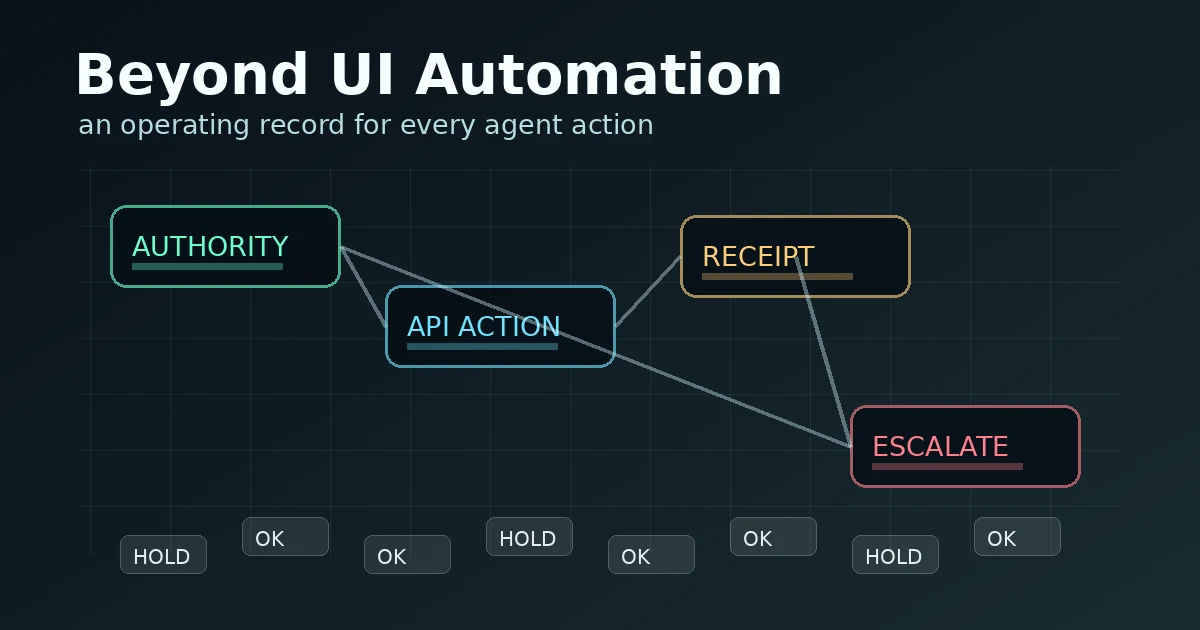
The Agent Action Ledger
The quiet shift in AI agents is not that they are getting better at clicking buttons.
That was the demo phase. An agent watched a screen, moved through an app, filled a form, copied a value, and looked impressive because it behaved like a very patient intern. Sometimes that was useful. Often it was fragile. A changed button label, a surprise modal, a timeout, or a small permissions mismatch could turn the whole workflow into a guessing game.
The production shift is different. Business systems are starting to treat agents as direct actors.
Cognizant’s TriZetto Unify announcement, summarized in AI Agent Store’s May 30 brief, used a phrase worth keeping: AI agents as “first-tier consumers” through a headless API model. In plain English, that means the agent does not have to pretend to be a person using a screen. It can call the service directly. In that case, the agent is not merely operating software. The software is making room for the agent.
That is a better architecture. It is also a sharper responsibility.
Once an agent can act through an API, the question is no longer “Can the model figure out the interface?” The question becomes “What action is this agent allowed to take, what proof does it leave, and who can reverse or review it?”
The missing artifact is an action ledger.
UI automation was never the destination
UI automation is seductive because it makes the future visible. You can watch the cursor move. You can see the fields fill. A non-technical buyer understands the magic immediately: the agent is doing the thing a person used to do.
That visibility hides the weakness. A screen is a human interface, not an operating contract. It was designed to guide a person who can notice context, recover from ambiguity, and stop when something feels wrong. When an agent uses that same surface, it inherits all the ambiguity but none of the human common sense. The workflow may work in a recorded demo and still be unsafe as a recurring business process.
API-first agent work is cleaner because it exposes the actual operation. Submit this request. Retrieve this record. Check this status. Create this case. Escalate this exception. The action is no longer buried behind a browser ritual. It is named.
That naming matters. A named action can be governed. It can be permissioned. It can be measured. It can return a receipt. It can be tested without pretending a button click is the unit of work.
But direct access also removes a comforting illusion. When the agent stops clicking around and starts calling the business system directly, you can no longer pretend it is “just assisting.” It is participating in operations. Even if the action is small, the architecture has crossed a line.
That line is where most agent programs need to get more boring, not more ambitious.
Governance has moved from data to action
Snowflake named the new perimeter clearly in its May 27 announcement that it intends to acquire Natoma. The release says Snowflake wants to create a “governance and identity layer for AI agents and MCP tool access,” making it easier to manage how AI systems interact with enterprise applications, databases, APIs, and tools.
The important part is not the acquisition. The important part is the shape of the problem.
For years, enterprise governance mostly meant governing data. Who can see it? Where is it stored? Which table is trusted? Which dashboard is official? That still matters. But agents add a second perimeter: what can the system do after it sees the data?
A sales agent that reads CRM history is one risk. A sales agent that updates the forecast, changes the deal stage, sends the customer a follow-up, and schedules a discount approval is another risk entirely. The model may be the same. The operational class is not.
This is where loose agent language starts to break down. “Connected to our tools” is not enough. Connected how? Read-only? Draft-only? Act with approval? Act independently under a dollar limit? Escalate when confidence drops? Stop when the account is regulated? Leave a receipt for every external change?
Those are not policy details to add later. They are the system.
AWS made the same point from the security side in its AI Security Framework, updated May 26: “You aren’t adding security to AI. You’re building AI on top of security.” That sentence is useful because it reverses the usual sequence. The common sequence is to build a flashy pilot, then ask security to approve it. The production sequence is to start with identity, access, monitoring, and controls, then let agents operate inside those rails.
For agents, security is not a gate at the end. It is the ground under the workflow.
The ledger is the product of trust
An action ledger is the record of what an agent was allowed to do, what it actually did, and what evidence proves the action happened.
It is not just a log file. Logs are often written for engineers after something goes wrong. A ledger is written for operations before responsibility becomes vague. It gives a manager, auditor, reviewer, or future agent enough truth to understand the work without reconstructing it from scattered traces.
A useful action ledger answers six questions for every meaningful agent action:
- What was the agent trying to accomplish?
- What authority did it have at that moment?
- What system, record, or person did it touch?
- What changed?
- What receipt proves the change happened?
- What review, rollback, or escalation path exists if the change is wrong?
That may sound heavy until the first agent touches something that matters. A prior authorization workflow in healthcare is a clean example. If an agent gathers documentation, checks eligibility, drafts or submits a request, and routes exceptions to a human, the organization cannot rely on “the AI handled it” as the operating record. It needs to know which patient record was used, which payer rule applied, what was submitted, what came back, which step required human judgment, and which step was only coordination.
That is not bureaucracy. That is how people trust a workflow that can move faster than people can watch.
The same pattern applies in professional services. An agent that prepares a client renewal packet needs to show which contract version it used, which dates it extracted, which exceptions it found, and whether it sent anything externally. An agent that updates a CRM needs to show the old value, the new value, the trigger, and the approval state. An agent that drafts invoices needs to separate calculation, recommendation, approval, and issuance.
The more direct the agent access, the more explicit the ledger has to be.
Autonomy levels are action levels
A lot of teams classify agents by intelligence. That is the wrong axis for production.
The useful axis is action.
An agent can observe. It can recommend. It can draft. It can act with approval. It can act independently within limits. It can coordinate with other agents. It can trigger workflows that affect customers, money, records, legal obligations, or clinical decisions.
Each level needs a different control surface. A read-only research agent does not need the same ledger as a billing agent. A drafting agent does not need the same rollback path as an agent that submits a form to an external system. A calendar assistant does not need the same escalation protocol as an agent operating inside healthcare administration.
This is the practical mistake behind many stalled agent pilots. The team treats “agent” as one category, then tries to govern everything with one review process. The low-risk work becomes slow. The high-risk work remains under-controlled. Humans get stuck approving too much, reviewing too little, and trusting the wrong signals.
A better pattern is to map the workflow by action rights:
- Observe: may read defined sources and summarize.
- Prepare: may draft outputs but not change records.
- Recommend: may propose next actions with rationale and evidence.
- Act with approval: may execute only after a named human approves a named action from a named state.
- Act within bounds: may execute low-risk actions under explicit limits, with receipts and sampling review.
- Escalate: must stop and route when conditions exceed its authority.
That map is simple enough to use and strong enough to expose bad design. If nobody can say which level an agent is operating at, the system is not ready for production.
The operator question changed
The old operator question was, “Can an agent do this task?”
The better question is, “What is the smallest action we can safely let an agent own?”
That question forces the work into a usable shape. It separates reading from changing. It separates drafting from sending. It separates approval from execution. It separates clinical, legal, financial, or managerial judgment from coordination work that can be safely accelerated. It turns vague automation into an operating design.
This is also where small businesses and professional-service firms have an advantage if they do not overcomplicate it. They do not need a giant governance program to begin. They need one workflow, one permitted action, one receipt, one review gate, and one rollback path. Then they can expand from evidence instead of excitement.
For example, do not start with “build an AI operations agent.” Start with: the agent may read new intake forms, classify the request, draft the first response, and create a task for a human. It may not send the response. It may not change billing status. It may not promise a delivery date. Every task it creates must include the source form, the classification reason, and the next recommended action.
That is not less ambitious. It is how ambition survives contact with real work.
Agents that work leave receipts
The next phase of AI agents will look less like magic and more like plumbing. That is good.
Agents should not have to operate every business through a screen built for humans. They should be able to call the right service, retrieve the right context, complete the right coordination step, and hand the right exception to a person. Agent-ready APIs are a sign that the market is moving in that direction.
But agent-ready does not mean agent-safe.
An agent becomes safe when its actions are bounded, visible, reviewable, and recoverable. The model can supply reasoning. The API can supply access. The workflow still needs the ledger that connects authority to action and action to proof.
That is the operating layer most teams will be tempted to skip because it does not demo well. Nobody claps for a clean receipt trail. Nobody posts a viral clip of a rollback path. Nobody calls a permission map futuristic.
Then something breaks, and those boring artifacts become the only things that matter.
Stephen’s operating view is simple: agents that actually work are not defined by how human they look. They are defined by the work they can safely own. The unit of progress is not a smarter demo. It is a smaller, clearer, better-governed action that can survive production.
Before you give an agent another tool, write down the action ledger it will have to leave behind.
Sources
- Snowflake, “Snowflake Announces Intent to Acquire Natoma, Providing Secure Connectivity For The Agentic Enterprise,” May 27, 2026: https://www.snowflake.com/en/news/press-releases/snowflake-announces-intent-to-acquire-natoma-providing-secure-connectivity-for-the-agentic-enterprise/
- AWS Security Blog, “The AWS AI Security Framework: Securing AI with the right controls, at the right layers, at the right phases,” updated May 26, 2026: https://aws.amazon.com/blogs/security/the-aws-ai-security-framework-securing-ai-with-the-right-controls-at-the-right-layers-at-the-right-phases/
- AI Agent Store, “Daily AI Agent News - Last 7 Days,” accessed May 30, 2026: https://aiagentstore.ai/ai-agent-news/this-week
Stephen Nickerson.
Built for operators who need AI agents they can test, trust, and improve.