AI Agents Need Action Lanes, Not Trust Switches
The easiest way to ruin a useful AI agent is to ask the wrong governance question.
Most teams ask whether the agent should be trusted. That sounds responsible, but it compresses several different operating decisions into one vague switch. An agent that reads a policy document is not doing the same job as an agent that drafts an email. An agent that recommends a refund is not doing the same job as an agent that issues one. An agent that updates a CRM field is not doing the same job as an agent that changes a customer’s contract, sends a message, or approves a payment.
Those are not degrees of the same permission. They are different action lanes.
That distinction matters now because agent projects are moving out of demo space and into production work. Gartner’s May 2026 warning, carried in public tech coverage this week, named the failure mode plainly: enterprises are treating agent governance as binary, “either locked down or fully trusted,” and that is becoming a root cause of failure. The same coverage points to a sharper operating distinction: teams fail when they do not separate an agent’s ability to act from the scope of access it has been granted.
That is the useful sentence. Ability to act and scope of access are different variables. If they are collapsed into one trust decision, the system will usually fail in one of two directions. It will over-restrict simple agents until people route around the controls, or it will under-restrict autonomous agents until the first production incident becomes the governance review.
Neither failure is a model problem at the start. It is an operating-design problem.
Binary trust creates bad agents on both sides
A locked-down agent can still be a bad system.
If every agent is forced into the same cautious lane, the business loses the point of using agents at all. Simple read-only work becomes slow. Drafting work gets buried in manual steps. Low-risk actions sit behind approvals that nobody has time to inspect. The team starts calling the agent “safe,” but what it really means is that the agent cannot carry enough work to matter.
That creates shadow automation. People copy data into personal tools. They run side workflows outside the approved system. They use personal accounts because the official agent has no useful access. The organization thinks it reduced risk by locking everything down, but it may have moved the real work into places with less logging, less identity control, and less accountability.
A fully trusted agent creates the opposite problem. It can move too quickly through systems that were never designed for an autonomous worker. A demo agent can use a human’s credentials, touch broad data, and write directly into a system of record because the prototype is being watched. Production is different. The moment the agent can act without someone staring at every step, the trust question becomes too blunt to protect the workflow.
The right answer is not to trust agents more. It is to stop using trust as the unit of design.
The lane is the job
An agent action lane defines what kind of work the agent is allowed to perform and what governance belongs to that work.
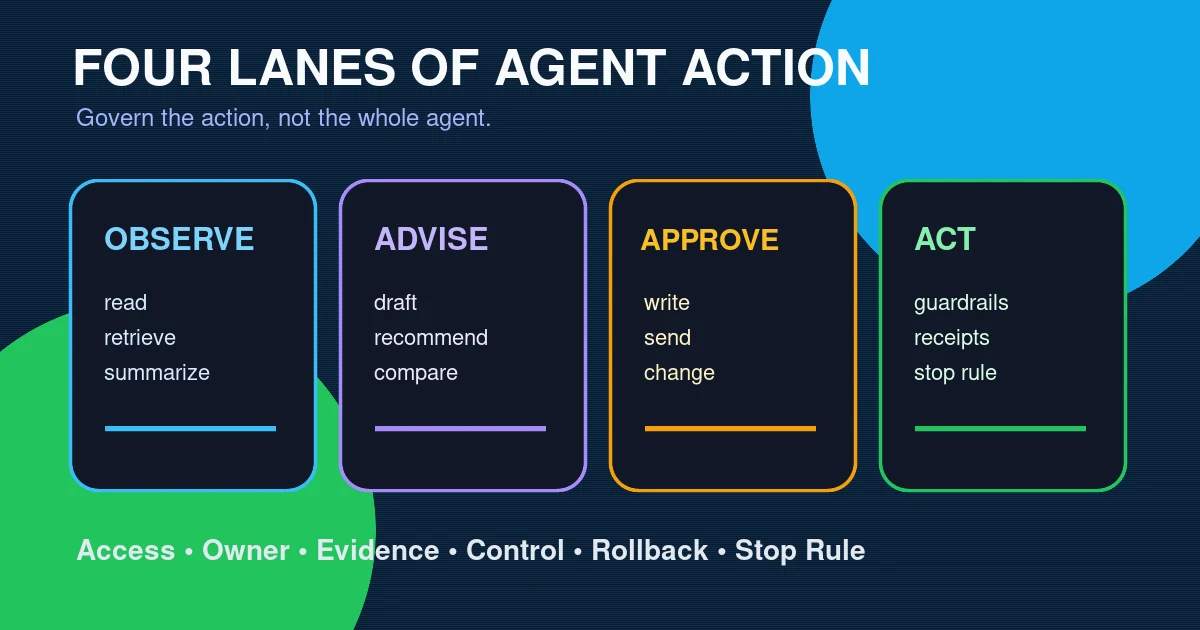
The simplest useful split is four lanes: observe, advise, act with approval, and act autonomously. Those names are not decorative. Each lane has a different operating product.
An observe agent reads, retrieves, summarizes, classifies, or explains. It may touch defined data sources, but it does not propose a business action and does not change a system. The primary risk is data exposure, inaccurate summary, or misplaced confidence in retrieved information. The controls should be light but real: scoped access, user authentication, usage logs, and basic testing.
An advise agent produces a recommendation, draft, analysis, or proposed next step. It still does not execute the action. This lane is where a lot of professional-service AI belongs at first: draft the email, prepare the report, identify the likely issue, suggest a response, propose the next move. The risk is no longer only exposure or accuracy. The agent can now influence human judgment. That means the control has to include quality checks, domain review, and training on when the output is a suggestion rather than a decision.
An act-with-approval agent can prepare and execute a change, but only after a human approves the specific action. This is where many teams think “human in the loop” solves the problem. It does not, unless the approval is still meaningful. Gartner’s quoted warning on this point is strong: human review is effective only if it remains a meaningful control. Without clear approval workflows, audit trails, agent-specific incident response, and security testing, approval can decay under time pressure or approval fatigue.
An autonomous-action agent acts inside defined guardrails without a human approving every individual step. At that point the review pattern changes. Humans inspect exceptions, logs, thresholds, and outcomes. The controls have to include continuous monitoring, rollback paths, circuit breakers, stop rules, and named ownership for agent behavior.
These lanes should not be mixed casually. A customer-support agent may observe the customer record, advise a response, act with approval on a refund, and act autonomously on a low-risk tag. That is fine if each action has its lane. It is dangerous if the whole agent is simply labeled trusted.
Approval fatigue is a design smell
Human-in-the-loop is often treated as a magic phrase. Put a person somewhere in the flow and the system feels safer.
That only works when the person is being asked to make a real decision with enough context, enough time, and enough evidence. If every agent action triggers the same approval pattern, the review gate becomes noise. People approve because the queue is long. They approve because most items are harmless. They approve because the interface makes rejection inconvenient. They approve because the work has already been shaped by the agent and there is no clean way to inspect the underlying facts.
That is approval fatigue. It is not a human weakness. It is a system telling the human to provide judgment where the architecture has not earned it.
A meaningful approval gate has a clear decision. What changed? What evidence supports the change? What authority is being used? What happens if the human says no? What risk class is this action in? What is the rollback path? What pattern should trigger escalation rather than another approval button?
If those questions are not visible, the human is not reviewing. They are absorbing liability.
The practical correction is to reserve approval for actions where judgment actually matters. Low-risk repeatable actions can be automated with strong logging and thresholds. Medium-risk actions can be approved with a concise evidence packet. High-risk actions can require second review, explicit owner sign-off, or no automation at all. The point is not to remove humans. The point is to put human attention where it remains a control instead of a ritual.
Security is the floor, not the patch
AWS’s AI Security Framework uses a line that should be stapled to every agent project: “You aren’t adding security to AI. You’re building AI on top of security.”
That is exactly right. Agent governance fails when security arrives after the demo has already defined the operating assumptions. The prototype agent used broad access because that was convenient. It wrote into systems because the team wanted to prove value. It borrowed a human identity because provisioning a separate one felt slow. It skipped logs because there was nothing to audit yet. Then the prototype becomes useful, and the organization tries to retrofit control onto a workflow that already learned bad habits.
Action lanes prevent that. They force the security conversation to happen at the level where work actually changes.
What can this agent read? What can it draft? What can it recommend? What can it write? What can it send? What can it approve? What can it delete? What credentials does it use? What receipt does it leave? What monitoring exists? What threshold stops it? Who owns the outcome when it acts correctly but the result is still bad?
Those questions sound heavier than a demo. They are also what makes the demo safe enough to become capacity.
Small teams do not need enterprise ceremony to use the pattern. A small business can map one workflow with a spreadsheet: action, lane, data touched, owner, approval rule, evidence, rollback, stop condition. A professional-service firm can do the same for intake, research, drafting, follow-up, CRM updates, and billing support. A larger organization may need identity brokering, policy enforcement, audit logging, incident response, and continuous monitoring. The scale changes. The architecture does not.
Build the Agent Action Lane Map
The artifact is simple: an Agent Action Lane Map.
For every meaningful action in the workflow, write down seven things.
- Action: What is the agent trying to do in plain language?
- Lane: Is this observe, advise, act with approval, or act autonomously?
- Access: What data, tools, APIs, accounts, or systems can the agent touch?
- Owner: Who is accountable for the action and its result?
- Evidence: What receipt shows what the agent saw, decided, changed, or recommended?
- Control: What approval, policy, guardrail, threshold, or test applies?
- Stop rule: What makes the agent pause, escalate, roll back, or shut off?
This map does two things immediately. It exposes places where the agent has too much authority for the work. It also exposes places where the agent has too little authority to be useful.
That second point is important. Good governance is not the art of saying no. Good governance is the art of letting the right work move at the right speed with the right proof. A read-only research agent should not wait behind the same gate as an autonomous billing agent. A low-risk tagging agent should not inherit the same controls as an agent that sends client communications. A drafting agent should not be judged like a decision-making agent.
Once the lanes are visible, the team can make cleaner decisions. Move this action down to advise. Move that action up to act-with-approval. Remove broad write access here. Add a receipt there. Automate this low-risk repeatable step. Keep that judgment human because the judgment is the product.
That is how agent systems become manageable.
Bottom line
The market is going to keep asking whether AI agents can be trusted. Operators should ask a better question.
Trusted to do what?
Reading is not recommending. Recommending is not writing. Writing is not sending. Sending is not approving. Approving is not acting alone. Each action has a lane, and each lane has its own access, evidence, owner, control, and stop rule.
Binary governance makes agents either useless or dangerous. Action lanes make them workable.
That is the difference between AI theater and agents that actually work.
Sources
- DIGIT, “Governance Failures Will Drive AI Agent Abandonment,” May 26, 2026, https://www.digit.fyi/governance-failures-will-drive-ai-agent-abandonment/
- CXOtoday, “Uniform Governance Is a Death Sentence for Enterprise AI Agents: Gartner,” May 26, 2026, https://cxotoday.com/ai/gartner-uniform-governance-is-a-death-sentence-for-enterprise-ai-agents/
- AWS Security Blog, “The AWS AI Security Framework: Securing AI with the right controls, at the right layers, at the right phases,” originally May 15, 2026, updated May 26, 2026, https://aws.amazon.com/blogs/security/the-aws-ai-security-framework-securing-ai-with-the-right-controls-at-the-right-layers-at-the-right-phases/
- Okta, “AI Agents at Work 2026: Securing the agentic enterprise,” accessed May 31, 2026, https://www.okta.com/newsroom/articles/ai-agents-at-work-2026-agentic-enterprise-security/
Stephen Nickerson.
Built for operators who need AI agents they can test, trust, and improve.