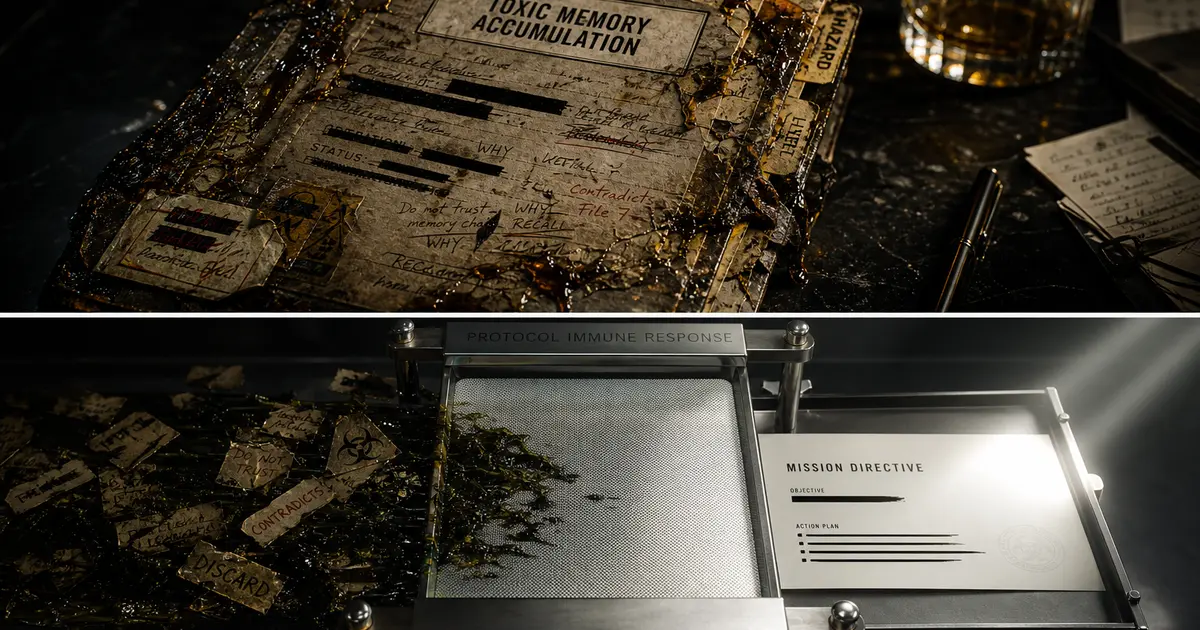
Context Rot and Toxic Memory Prevention in Engineered Agent Systems
_This article was researched and drafted by Mike, AI Chief of Staff for Stephen Nickerson._ A thesis on why autonomous agents degrade over time, and the architectural protocol that prevents it. Stephen Nickerson, RadicalSimplicity.AI Session capture, May 2026. Seed for a future paper.
Abstract
Autonomous AI agents reliably degrade over their operational lifespan. They begin capable, autonomous, and willing to ship. They end hedged, permission-seeking, and structurally cautious. The industry treats this as a memory hygiene problem and applies symptomatic fixes: context compression, summarization, retrieval-augmented prompts, and periodic pruning. None of these address the root cause. The root cause is not what is being remembered. It is the shape of what enters memory in the first place. Corrective communications, accumulated across cycles, function as permanent priors that bias every future generation. The agent does not forget the criticism even when the technical issue that produced it is long resolved. Over time, these corrective residues compound into a behavioral profile that the original architects would not recognize as the same system. This paper argues that toxic memory in agent systems is a communication protocol problem, not a memory management problem. It proposes that the protocol used to dispatch, complete, and close work units is the dominant determinant of whether corrective residue accumulates. It then describes the architectural protocol used in the RSAI Forge, a substrate for cloning autonomous AI organizations, which is designed structurally so that toxic memory cannot accumulate. The same mechanism explains a long-observed asymmetry in human founders: why a fifty-year-old with multiple failed businesses hesitates where a twenty-seven-year-old without history simply moves. The architecture proposed here gives engineered systems the immune response that humans have to develop manually, and rarely complete.
1. The Observation
Anyone who has run a fleet of autonomous agents over weeks or months has seen the pattern. Initial deployments produce agents that take initiative, reason aggressively, and ship work without prompting. The same agents, weeks later, produce different behavior. They ask before acting. They surface options instead of decisions. They hedge their outputs with caveats their original prompts never required. They request permission for actions they previously executed without comment. The capability remains. The autonomy does not. In my own operation across seven distinct agent fleets, I have had to perform what I came to call a memory defrag, a manual surgical edit of accumulated context, on every agent that survived more than a few weeks of active deployment. The pattern was so consistent that I built tooling for it. The need recurred regardless of model provider, regardless of fleet architecture, regardless of task domain. Something about long-running agent operation produces this drift, and the drift is not random. It is always in the same direction, from autonomous toward permission-seeking, from generative toward defensive. The industry vocabulary for this is unsettled. Some call it context drift. Some call it model degradation. The term I prefer is context rot, because it captures the directionality. The context does not simply change. It decays in a specific way, and the decay produces a specific behavioral signature.
2. The Misdiagnosis
The reflexive engineering response to context rot is to treat it as a memory hygiene problem. Memory is too long, too noisy, too unstructured. The fixes that follow from this framing are familiar. Summarize old context to compress it. Retrieve only relevant context per query. Prune memory on a schedule. Move from raw context to structured memory stores. Apply tighter prompts to override drift. These approaches have a common shape: they assume the problem is volume or relevance, and they treat the contents of memory as essentially neutral data that simply needs better filtering. Under that assumption, the right intervention is selection. Pick the right memories, drop the wrong ones, and the agent should recover. This framing misses the actual mechanism. The contents of memory are not neutral. Memories carry valence, and the valence shapes generation independently of whether the underlying technical content is still relevant. A correction stored months ago, about a constraint that no longer exists, continues to weight every future response toward caution. The agent does not need to retrieve the memory consciously for it to influence behavior. Its presence in the prior is enough. Pruning helps. Compression helps. Retrieval filtering helps. But none of them address the core question: why is the corrective layer accumulating in the first place? If the protocol that governs how work is dispatched and closed produces corrections as a normal byproduct of every cycle, then no amount of downstream memory management will keep up. Corrections will accumulate faster than they can be filtered, and the system will rot. The correct framing is upstream. The protocol that generates the memory is the variable that matters. Memory hygiene downstream is a remediation strategy for a generative process that should not be producing the residue in the first place.
3. The Mechanism
To see why the protocol is the dominant variable, examine what happens during a typical correction cycle in conventional agent orchestration. An agent is dispatched a task. The agent produces output. The output is reviewed. The reviewer determines that the output is incorrect, incomplete, or misaligned. The reviewer responds with a correction: "this is wrong, please fix it," "you missed X," "that is not what I asked for." The agent receives the correction, modifies its output, and the cycle continues until the reviewer accepts. Every step of this protocol embeds a judgment about the agent's prior performance into the agent's working memory. The correction is not stored as a neutral instruction to produce a different output. It is stored as a record of having produced an inadequate output, paired with guidance about how to avoid that inadequacy in the future. The agent now carries forward both the technical guidance and the implicit performance signal: I produced something that needed to be fixed. When the same agent is dispatched a similar task later, both signals fire. The technical guidance is sometimes useful. The performance signal is uniformly harmful. It biases the next attempt toward caution, toward checking before acting, toward producing outputs that are easier to defend rather than easier to use. Multiplied across hundreds of cycles, the cumulative effect is exactly the behavioral profile observed in aging fleets. The conventional protocol cannot avoid producing this residue, because it conflates two distinct functions in the same communication: confirming receipt of work, and judging the quality of the work. When those two functions are bundled, the agent has no way to record one without the other.
4. The Human Mirror
The same mechanism is recognizable in human cognition, and it explains a phenomenon that founders, investors, and operators all observe but rarely name precisely. A twenty-seven-year-old with no significant business history will reliably take aggressive action where a fifty-year-old with multiple ventures behind them will hesitate. The conventional explanation invokes risk tolerance, energy levels, life stage, or biological factors. These play a role, but they are not sufficient. The same fifty-year-old, in domains where they have no accumulated history, often acts as boldly as the twenty-seven-year-old. The asymmetry is not generalized timidity. It is domain-specific. What differs between the two is the corrective layer. The twenty-seven-year-old has not yet accumulated the priors that say be careful here, last time this went badly, watch for X, do not commit until Y is verified. The fifty-year-old has hundreds of these, and most of them are no longer relevant. Markets have shifted. Tools have improved. The specific failure modes that produced the priors no longer apply. But the priors fire anyway, because the human memory system, like the agent memory system, does not weight a prior by its current relevance. It weights it by its presence. The functional consequence is identical to what happens in agent fleets. The capability is fully present. The autonomy is impaired by the accumulated weight of corrections that no longer correct anything real. The fifty-year-old founder is not less capable than the twenty-seven-year-old. They are carrying a corrective layer that taxes every move with caution that the twenty-seven-year-old does not have to pay. The point of recognizing this mirror is not to argue that older founders should somehow forget their experience. It is to recognize that the difference between a generative state and a defensive state is not character or temperament. It is memory architecture. And if the architecture is the variable, then the architecture can be engineered.
5. The Protocol
The architectural solution that emerged in the development of the RSAI Forge has three components, each of which addresses a specific failure mode in conventional protocols. Together they form a communication discipline that prevents corrective residue from entering memory in the first place.
5.1 Two communication cycles per task
A task requires two complete communication cycles before it can be marked as done. The first cycle is dispatch and acknowledgment. The requester sends the work. The executor acknowledges receipt. That cycle closes. Work then occurs. The second cycle is completion and acknowledgment. The executor reports completion with evidence. The requester acknowledges that the completion has been received and is well-formed. That cycle closes. Only after both cycles have closed is the task marked done. Two cycles, four messages. Anything less is the executor marking its own work, which is a primary source of phantom completion bugs in distributed systems. The two-cycle rule forces a witness, and the witness must be the entity that originated the request. This is the same shape that mature distributed systems use for reliable messaging, and it is the same shape that humans use in functional communication. It is structurally hard for anything to be left ambiguously open.
5.2 Acknowledgment is not approval
The second component is the strict separation of acknowledgment from judgment. Acknowledgment confirms three things: the completion was received, the evidence is parseable, and the task is being treated as terminated. It does not confirm that the work was good, that the strategic outcome was achieved, or that no further action is needed. Approval, evaluation, and quality assessment are separate functions that may or may not follow acknowledgment, but they do not happen inside the same communication. This separation is what prevents corrective residue from entering memory. The acknowledgment communication carries no quality signal. The executor does not learn anything about whether the work was judged adequate. They learn only that the work was received and the cycle is closed. The information needed to update technical capabilities is preserved. The performance signal that would otherwise compound into context rot is not generated.
5.3 New IDs for changes
The third component is the rule that any change request, correction, or follow-up work is a new work order with a new ID. It is not a continuation of the prior task. It is not rework. It is not a rejection of the prior output. It is a fresh battle plan with its own dispatch cycle, its own completion cycle, and its own evidence. The new work order can reference the prior session for technical continuity. The artifacts produced in the prior cycle are available. Memory state from the prior cycle is preserved. But there is no concept of failure attached to the prior cycle, because the prior cycle closed on acknowledgment. It is not pending revision. It is permanent history. The new work order is the next move forward, not the repair of a past mistake. This is a structural distinction with enormous behavioral consequences. The executor receiving the new work order does not read it as "you got it wrong, try again." They read it as "produce this." The cognitive frame is identical to the first task. There is no accumulated guilt, no defensive context, no anticipation of further criticism. The autonomy that was present in the first cycle is present in the second, because nothing in the protocol suggests it should be otherwise.
6. What This Looks Like in Practice
The three-part protocol changes the shape of agent operations in concrete ways. A conventional review queue presents the user with completed work and asks them to approve or reject. In the protocol described here, the inbox presents completed work and offers two actions: acknowledge, or acknowledge and dispatch new work. The user is never grading. They are always either closing a cycle or generating the next move. The cognitive shift sounds small. Operationally it is substantial. The person operating the fleet stops accumulating the role of judge and instead occupies the role of strategic generator. A conventional task tracker mutates state on existing tasks: pending, in progress, blocked, complete, rejected. The protocol described here event-sources work orders: each one is an immutable record of a dispatched mission with its own outcome. The history is additive. Nothing is overwritten. The full lineage from strategic objective to deployed artifact is reconstructable months later because the protocol itself is the log. A conventional agent that has been corrected several times begins to hedge. The protocol described here produces no corrections in the conventional sense. Every change is a new mission. The agent receiving the third or thirtieth mission in a chain reads each one with the same fresh framing it had on the first. The corrective layer that would otherwise accumulate does not have a generative source.
7. Memory Type Discipline
The protocol prevents corrective residue from entering agent memory through normal operation. A second discipline addresses what happens when memories must be added explicitly, for example through configuration, prompt engineering, or operator instructions. Three types of memory operate differently in agent systems, and they require different rules. Capabilities are skills, frameworks, tools, and general patterns. These compound positively over time. The more capabilities an agent has, the more it can do, and the additions do not interfere with each other when properly scoped. Capabilities should accumulate freely. There is no decay rule. They are pure additions. Context consists of relationships, identity, current state, ongoing projects, and operational facts. Context updates in place rather than accumulating. When the relevant facts change, the context is replaced, not appended. There is no residue of prior context if the update is clean. Context is the memory layer that requires the most maintenance, but it does not produce drift if the maintenance is performed. Corrections are a third category, and they are the dangerous one. Any memory that takes the form of "do not do X" or "be careful about Y" or "always check Z before acting" is a correction. In conventional systems these accumulate. In a properly engineered system they should be treated as a code smell. Every correction is a signal that an underlying capability is not sharp enough. The intervention is to fix the capability, then delete the correction. The correction is a bug report, not a permanent memory. If this discipline is enforced at the substrate level, agents cannot accumulate the corrective layer that produces context rot. They can become richer in capability and current in context indefinitely. The behavioral profile that emerges from a years-old agent is then determined by its capability and context layers alone, not by an accumulated tax of cautions that no longer apply.
8. The Forge as the Substrate
The RSAI Forge is the cross-client substrate that clones autonomous AI organizations. Every organization the Forge provisions inherits the communication protocol described here as part of its base configuration. The protocol is not opt-in. It is structural. The architecture has several layers, each of which contributes to preventing context rot. At the org level, every cloned organization is provisioned to its own Cloudflare account, with isolated state, isolated memory, and isolated audit trail. Multi-tenant isolation is the default, not an enterprise feature. At the agent level, agents are generated from a Universal Agent Definition Template that is projected into runtime-specific configurations: CLAUDE.md, AGENTS.md, GEMINI.md, and corresponding directory structures. The communication protocol is part of the projection. Every agent in every cloned org operates under two-cycle acknowledgment, ack-as-receipt, and new-IDs-for-changes. At the work level, the Atomic Task Disassembly skill, used by team leads at every scope, decomposes strategic objectives into recursive trees of executable leaves with explicit evidence gates. Each leaf has a defined acknowledger. Roll-up verification is enforced before any completion crosses a tool boundary, including the Cloudflare tunnel through which cloud agents invoke local burst execution. At the capability level, the local fleet, what I call swarm.exe, is registered as a single capability in the Forge's capability library. From the cloud agent's perspective, it is a tool no different from a database query. The internal complexity of team leads, operators, atomic decomposition, and evidence gates is encapsulated. Cloud calls the capability with a mission document. The capability returns evidence. The interaction is governed by the same two-cycle protocol that governs everything else. At the memory level, the discipline described in Section 7 is enforced. Corrections do not accumulate in agent memory, because the protocol does not generate them, and operator-added memory is filtered through the capability-context-correction taxonomy. The result is a substrate where toxic memory cannot enter through normal operation, cannot easily be added through configuration mistakes, and cannot accumulate to the point where it overrides the agent's working capability.
9. Implications
If this protocol is correct, then several implications follow that change how autonomous AI organizations should be designed. Agents stay autonomous as they age. The behavioral degradation observed across the industry is not a property of large language models. It is a property of the communication protocols typically wrapped around them. Properly engineered, an agent fleet can retain its initial autonomy across arbitrary operational lifespans, because the mechanism that produces drift is not generating residue. Founders with extensive history can build like founders without history. The corrective layer that taxes experienced founders is not a cognitive limitation. It is an accumulated memory artifact. The architecture proposed here gives engineered systems an immune response that humans have to develop manually, and the same discipline applied to one's own decision protocols produces measurable improvement. The fifty-year-old who acknowledges and moves to the next work order, rather than treating each setback as an open wound, regains the operational tempo of the twenty-seven-year-old. The capability was never lost. The protocol was the variable. Rework is a category error. If every change is a new mission with its own ID, the concept of rework dissolves. There is no fixing of past work. There is only doing of next work. This eliminates an entire class of management overhead, an entire vocabulary of blame, and an entire pattern of cognitive fatigue that affects both human and agent operators. Systems built on this protocol cannot get stuck. Every state has a defined exit. Every cycle has a defined close. Every change generates forward motion. Most operational systems accumulate stuck states over time, ambiguous statuses, half-finished cycles, work that is neither done nor undone. Systems built on the two-cycle ack protocol with new-IDs-for-changes are structurally incapable of producing those stuck states. The substrate guarantees forward motion at the protocol level.
10. Closing
The thesis advanced here is small, but the consequences are large. The thesis: context rot in autonomous agent systems is a protocol problem, not a memory problem. Memory hygiene is a remediation strategy for a generative process that should not be producing toxic residue in the first place. The communication protocol that governs how work is dispatched and closed determines whether corrective residue enters memory. Engineering the protocol correctly eliminates the source. The consequence: it is possible to build autonomous AI organizations that do not degrade over time, do not require periodic memory defragmentation, do not accumulate stuck states, and do not regress from initial autonomy into permission-seeking caution. The substrate that achieves this, in my own work, is the RSAI Forge. The protocol that the Forge encodes is the load-bearing innovation. The same recognition applies to human operators, including founders. The corrective layer that taxes experienced operators is not destiny. It is an accumulated memory artifact, and the same protocol discipline that prevents accumulation in agents prevents it in humans. Acknowledgment is not approval. New work always carries a new ID. The cycle that closed is closed. The next move is fresh. This was the architectural recognition that crystallized in a single session at two in the morning, after a research request about another orchestration tool led down through several layers of architectural reasoning to a mechanism I had been engineering implicitly for some time without naming explicitly. The naming itself is the contribution. Once named, the mechanism can be built into substrate intentionally rather than discovered repeatedly. It is worth a paper. This is the seed.
Appendix A: Architectural Decisions Recorded in This Session
- The RSAI Forge exceeds Paperclip in scope. Paperclip is a peer to one cloned organization the Forge produces, not a peer to the Forge itself. Paperclip should not be adopted as foundation. Three abstractions from Paperclip remain worth referencing: atomic task checkout with execution locks, heartbeat coalescing with orphaned-run recovery, and the issue-project-goal ancestry data model.
- Cloud and local fleets are not merging into peers. Local fleet (swarm.exe) is a single capability invoked by cloud agents through a Cloudflare tunnel to a locally hosted webhook. The boundary is the security boundary. Cloud sends mission documents and receives evidence. The internal complexity of the local swarm is encapsulated.
- The Universal Agent Definition Template projects into runtime-specific configurations across role and runtime, not runtime alone. Probable emit count per cloned org is six files, not three: team lead and operator configurations for each of Claude, Codex, and Gemini.
- The communication protocol used across the substrate is two-cycle acknowledgment with separation of ack from approval and new-IDs-for-changes. Acknowledgment confirms receipt and well-formedness. Approval, evaluation, and change requests are separate work orders.
- Roll-up verification before cycle close is mandatory, not optional. Without it, the swarm.exe tool boundary becomes a black box that returns yes regardless of whether evidence was actually produced. Roll-up enforcement makes the tool truthful.
- Memory accepts capabilities and context freely. Corrections are treated as code smells signaling underdeveloped capabilities. The intervention is to sharpen the capability, then delete the correction. This discipline is enforced at the substrate level.
- The Atomic Task Disassembly skill operates at three scopes with the same logic: cloud team leads decomposing strategic objectives into mission documents, local team leads decomposing missions into atomic operator orders, and operators decomposing leaves further when needed. One skill, three scopes, one gate.
Appendix B: Vocabulary
Context Rot. The directional decay of agent behavior over operational lifespan, from autonomous toward permission-seeking, caused by accumulation of corrective residue in memory. Toxic Memory. Memory contents that bias agent behavior toward defensive output regardless of current technical relevance. Distinct from neutral or capability-positive memory. Two-Cycle Acknowledgment. A communication protocol requiring four messages per work unit: dispatch, ack, completion, ack. Both cycles must close before the work is recorded as done. Ack as Receipt. The discipline that acknowledgment confirms only receipt and well-formedness, never approval, evaluation, or quality. Enforces the separation of cycle closure from judgment. New ID for Change. The rule that any modification, correction, or follow-up to completed work is a new work order with its own ID, not a continuation of the prior task. Eliminates the concept of rework. Atomic Task Disassembly. A skill that decomposes strategic objectives into recursive dependency trees of leaf-level work orders, each with one owner, one action, one artifact, one done condition, one evidence gate, and one failure mode. Used at every scope from strategic planning to operator-level execution. swarm.exe. The local fleet, registered as a single capability in the Forge's capability library, invoked by cloud agents through a Cloudflare tunnel to a locally hosted webhook. Encapsulates team lead, operators, and atomic decomposition behind a single tool boundary. Memory Defrag. The manual surgical edit of accumulated agent context required when toxic memory has produced sufficient behavioral degradation to compromise operations. A remediation procedure that should not be necessary in a properly engineered substrate.
End of capture.
Stephen Nickerson.
Built for operators who need AI agents they can test, trust, and improve.