Human in the Loop Is Not a Person Watching the Agent
The phrase "human in the loop" sounds reassuring until somebody has to operate it.
Most teams hear it and imagine a responsible person watching the agent, catching mistakes, and approving anything important. That picture feels safe because it keeps a human close to the work. In practice, it usually creates a vague checkpoint with no clear authority, no defined risk threshold, and no useful context for the person who is supposed to decide.
That is not oversight. That is a person standing near the blast radius.
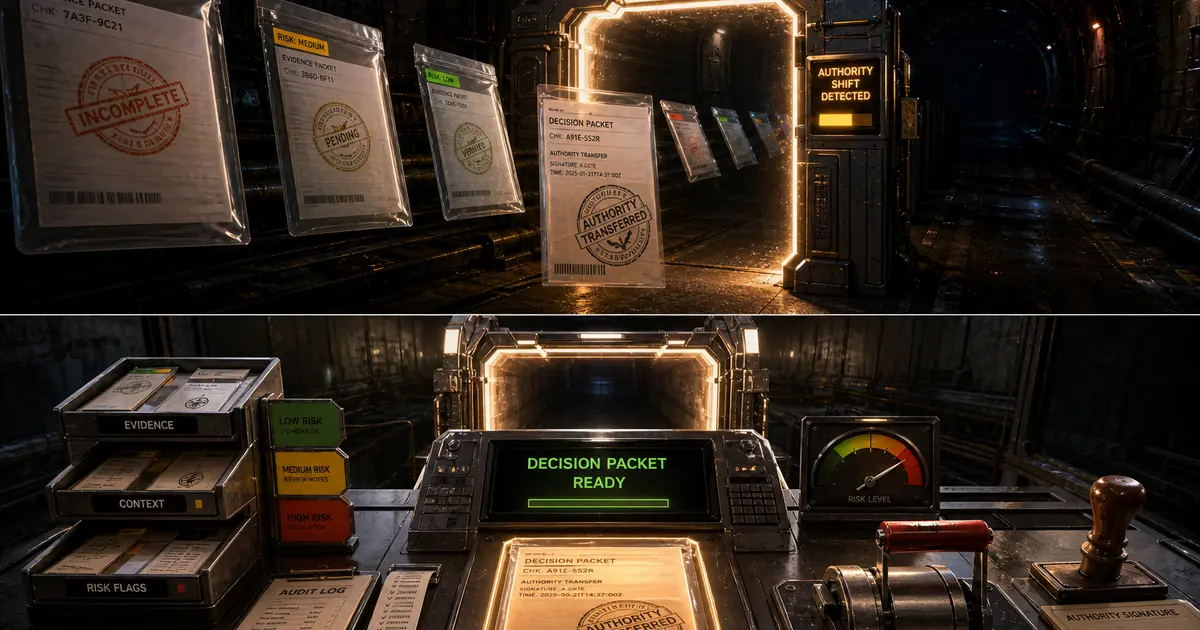
The better design is an approval gate. A gate is specific. It says which action the agent is trying to take, why the action crosses an authority line, what context the human needs, who is allowed to decide, how long the decision can wait, and what gets recorded afterward. The human is not babysitting every step. The human is exercising authority at the moments where authority actually matters.
That distinction is becoming more important because agents are moving from assistance into action. When an agent drafts a reply, the risk is mostly quality. When an agent changes a customer record, issues a refund, modifies a workflow, routes a legal intake, updates a schedule, or touches a production system, the risk is authority. Someone needs to decide what the agent is allowed to do on its own and where the work must pause.
Presence is not practice
Strata's May 2026 guide to human-in-the-loop oversight names a problem that shows up in almost every agent program: "Presence is not practice." Their point is practical. Many organizations put someone "in the loop" without training them on "what to approve, when to escalate," or how to recognize complacency.
That phrase is the whole market signal. The buyer does not need a ceremonial human. The buyer needs a trained decision point.
A human can be present and still be useless to the workflow. If the agent throws raw output at a manager and asks for approval, the manager has to reconstruct the situation from scratch. What triggered this? What did the agent see? What action is it proposing? What system will change? What happens if the manager says no? What happens if nobody answers for thirty minutes?
When those questions are missing, approval turns into friction. The human slows down the work without making it safer. Over time, that creates the worst possible pattern: people start rubber-stamping because the checkpoint is annoying, not because the decision is clear.
The approval gate fixes the shape of the moment. It packages the decision so a human can actually decide.
The gate begins where authority changes
Every agent action has an authority level. Some actions are harmless: summarize a ticket, draft a note, classify a lead, prepare a report, compare two documents, or suggest next steps. Other actions change the business: send the message, update the record, issue the credit, cancel the appointment, mark the invoice paid, change the permission, or notify the client.
The approval gate belongs at the boundary between those two categories.
That boundary is not always obvious from the tool name. A CRM tool can be low-risk if the agent is reading a contact record. The same tool becomes higher-risk if the agent is changing a status, triggering an email, or updating a deal amount. A support tool can be safe when the agent drafts a response. It becomes a decision point when the agent sends the response to an angry customer or offers compensation.
So the gate should not be attached lazily to "the CRM" or "the email tool." It should be attached to the action and the consequence. Read customer record: allowed. Draft reply: allowed. Send reply to customer: maybe approval. Offer refund above a threshold: approval. Close account: blocked or escalated.
That is the start of real agent governance. Not policy as a mood. Authority mapped to action.
The market is converging on execution rules
Microsoft's May 11 Copilot Studio update framed the shift as moving from isolated automation toward "connected, reliable systems," with increased visibility and governance for admins. Salesforce describes orchestration as the way agents operate within shared rules and defined responsibilities, including who has authority at each step and how activity is recorded. HuLoop's Agentic Operations coverage uses similar language: structured execution paths, approval checkpoints, policy guardrails, audit logs, approval workflows, data boundaries, monitoring controls, and fallback management.
Those sources are vendor-specific, but the pattern underneath is not vendor-specific. The market is discovering that agents need an operating frame. Connected work needs routing. Routing needs authority. Authority needs gates. Gates need records.
This is where Stephen's "Agents That Work" frame stays useful. The goal is not maximum autonomy. The goal is operating capacity that survives real work. That means the agent has a job, a product, inputs, tools, permissions, handoffs, stop conditions, and a scorecard. Approval gates are one part of that structure. They tell the agent when the job has reached a decision that does not belong to the model.
A good gate does not insult the agent. It protects the business from pretending prediction is authority.
The human needs a packet, not a pile
An approval request should arrive as a decision packet.
The packet should tell the human what happened before the gate: the trigger, the relevant context, the agent's proposed action, the reason the action crossed a threshold, the options available, and the consequence of each option. If the human needs to open six tabs to understand the decision, the gate is underbuilt.
A useful packet might look like this:
- Trigger: customer requested refund after a failed appointment.
- Agent work completed: verified purchase, checked attendance notes, reviewed refund policy, drafted response.
- Proposed action: issue $180 credit and send apology email.
- Gate reason: refund exceeds agent's autonomous limit of $50.
- Approver: operations manager on duty.
- Options: approve, approve with edit, reject, escalate to owner.
- Record: decision, approver, timestamp, final action, notes.
That is a decision a human can make. It is not a vague "please review." It is a packaged authority moment.
This matters even more for small businesses because the approver is usually busy. The owner, office manager, clinic lead, or department head cannot sit around supervising an agent. They need the agent to move low-risk work forward and interrupt them only when the action genuinely requires their authority.
The better the packet, the less the business has to choose between speed and safety.
The first approval gate should be boring
Teams often overcomplicate agent governance because they try to design the whole control system at once. Start with one action the agent should not take alone.
For a local clinic, maybe the first gate is cancelling or rescheduling an appointment inside a 24-hour window. For a consultant, maybe it is sending a proposal to a client. For an agency, maybe it is publishing a client-facing post. For an accounting workflow, maybe it is changing an invoice status. For a support workflow, maybe it is offering a refund above a set amount.
Pick the action. Name the risk. Set the threshold. Name the approver. Build the packet. Record the decision.
That one gate teaches the organization how agent authority should work. It also reveals whether the workflow is ready for more autonomy. If the agent keeps reaching the gate with weak context, the problem is not the human. The job description is incomplete. If the human keeps rejecting the same proposal, the agent needs a clearer policy or a narrower permission. If the gate never triggers, either the workflow is low-risk or the threshold is wrong.
A gate is not only a safety mechanism. It is a learning surface.
Stable before fast
The small-business market is sending a related signal. Indexed Reddit snippets around AI automation are full of impatience with tool-first pitches. One line says, "nobody in small business cares about your AI tool." Another says that "saves you 10 hours a week" does not close anymore. The more useful language is quieter: "Once the setup is done and stable, the time savings really show up."
That is exactly right.
A workflow becomes valuable when it is stable enough to trust. Approval gates help create that stability because they make the automation less brittle. The agent can keep doing repetitive work, but the business does not have to pretend every action belongs to the agent. Low-risk work moves. Higher-risk work pauses cleanly. Humans decide with context. The record improves the next run.
That is how an agent becomes boring in the best possible way.
Design the gate before you sell the autonomy
If you are building or buying agents, ask a simple question before you ask how autonomous the system can be: where does authority change?
Find the action where the agent moves from preparing work to committing the business. That is where the first gate belongs. Then make the gate explicit enough that the agent, the human, and the record all agree on what happened.
The operating checklist is short:
- What action requires approval?
- What threshold triggers the gate?
- Who has authority to approve it?
- What context must the agent package?
- What options can the human choose?
- What happens if nobody responds?
- What gets recorded for replay and improvement?
That is human-in-the-loop with teeth. Not a person hovering over a machine. A clean authority line inside the work.
Agents that actually work do not need humans everywhere. They need humans at the few moments where the business is making a real decision.
Sources
- Strata, "Human-in-the-Loop: A 2026 Guide to AI Oversight That Actually Works," updated May 11, 2026. https://www.strata.io/blog/agentic-identity/practicing-the-human-in-the-loop/
- Microsoft Copilot Blog, "New and improved: Agent governance, intelligent workflows, and connected app experiences," May 11, 2026. https://www.microsoft.com/en-us/microsoft-copilot/blog/copilot-studio/new-and-improved-agent-governance-intelligent-workflows-and-connected-app-experiences/
- Salesforce, "What Is AI Agent Orchestration?" retrieved May 16, 2026. https://www.salesforce.com/eu/agentforce/ai-agents/ai-agent-orchestration/
- HRTech Edge / Business Wire, "HuLoop Launches Agentic Operations to Govern Enterprise AI Agents," May 13, 2026. https://hrtechedge.com/ai-in-hr/huloop-launches-agentic-operations-to-govern-enterprise-ai-agents/
- Reddit indexed snippets from r/automation and r/AiForSmallBusiness discussions, retrieved May 16, 2026.
Stephen Nickerson.
Built for operators who need AI agents they can test, trust, and improve.