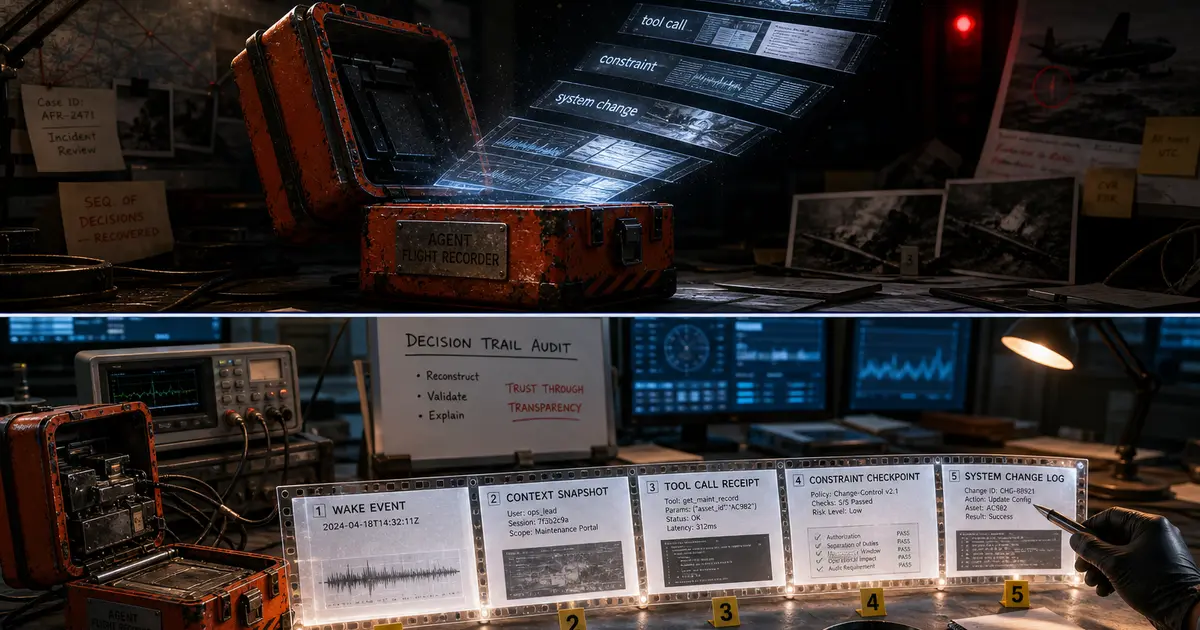
The Agent Wasn't Wrong. It Was Untraceable.
The enterprise AI conversation is moving past the model beauty contest. The sharper question now is operational: when an agent acts inside the business, can anyone reconstruct what happened?
That question sounds technical, but it is really managerial. An agent that drafts a paragraph can be judged by taste. An agent that triages an incident, updates a customer record, opens a ticket, routes a refund, or touches a production workflow has entered a different category of work. The business no longer needs a better screenshot of activity. It needs a record of action.
That is why the next useful proof layer for AI agents is not another dashboard. It is a flight recorder.
A dashboard tells you something is happening. A flight recorder tells you what happened, in what order, under which conditions, with which controls, and with enough detail that the next version of the system can be safer and more useful. If an agent is going to operate inside real work, that distinction matters.
The market is naming the same problem from several angles
On May 12, 2026, Honeycomb announced agent observability features for production AI workflows. The language was blunt: teams need "real-time visibility into what their agents are actually doing." Honeycomb framed the reason clearly. Agents are now handling code generation, incident triage, infrastructure deployment, and customer service, but older observability tools were not built for nondeterministic, multi-hop agent workflows. When something breaks, teams need to reconstruct what the agent decided and why.
That is the flight-recorder problem.
The same week, NVIDIA and SAP described a different side of the same issue. Their May 12 announcement around specialized enterprise agents emphasized isolated execution environments, policy enforcement, enterprise identity integration, auditing, and governance hooks. The phrase that matters is not the vendor name. It is the production requirement: agents that cross application boundaries need boundaries, policy enforcement, and an audit trail before they become part of work.
VentureBeat added the strategic frame on May 15: the next enterprise battle is not only models, but the agent control plane - the layer where agents plan, call tools, access data, run workflows, and prove to security teams that they did not do anything they were not supposed to do.
Different sources, same market movement. The public is no longer asking only, "Can the agent do it?" The more serious buyer is asking, "Can we see, constrain, replay, and improve what the agent did?"
Logs after the fact are not enough
Indexed Reddit snippets from AI agent discussions are already using the practical language buyers use before vendors polish it. One governance thread put it plainly: "logs alone are not enough" once agents have access to production systems. Another production-readiness discussion compressed the requirement into four words that are worth preserving: "reliability, permissions, observability and clean integrations."
That is a better buying signal than most analyst language because it names the lived problem. Operators do not want a compliance theater layer that produces a report after the damage is done. They want the workflow itself to know what an agent may see, what it may do, what requires approval, and what gets recorded for replay.
This is where a lot of agent programs get soft. A team writes a prompt, connects a tool, gives the agent a broad credential, and adds logging later. That may be enough for a demo. It is not enough for work that has customers, money, data, deadlines, or reputation attached to it.
The operating correction is simple: the record has to be part of the job, not an apology after the job.
A flight recorder starts before the agent acts
The first event in an agent flight recorder is not the tool call. It is the wake-up event.
Something tells the agent there is work to do: a ticket, a webhook, a queue item, a cron job, a form submission, an email, an alert, or a human request. If you cannot name that event, you do not yet have an agent operating system. You have a loose assistant with tools.
The wake-up event matters because it defines the beginning of the record. What condition started the work? What payload arrived? Which customer, account, system, or workflow did it relate to? Was the event inside the agent's authority, or should it have been rejected before any model call happened?
Then comes context. What did the agent see? Which documents, records, messages, metrics, or prior decisions were included? Which data was deliberately excluded? In ordinary software, this may feel like plumbing. In agentic work, it is judgment scaffolding. If you cannot reconstruct context, you cannot explain the decision.
Then come the action points: which tool was called, what arguments were passed, what permission allowed the call, what result came back, and whether a human approved the step. For multi-agent workflows, the record also needs the handoff: who passed work to whom, what changed in the handoff, and what product each agent was responsible for producing.
A useful flight recorder captures the sequence a competent operator would ask for after a failure:
- What woke the agent up?
- What job was it assigned?
- What context did it receive?
- What data was it allowed to read?
- Which tools did it call?
- Which actions were proposed, approved, denied, or executed?
- What changed in the system?
- What failed, retried, escalated, or stopped?
- What should be changed in the job description before the next run?
That last question is the reason the record is valuable. A flight recorder is not only for blame. It is for correction.
Governance becomes real when it changes the workflow
The word governance has become dangerously easy to say. A policy document can say the right things while the agent still holds the wrong keys.
Real governance changes the path of action. It decides whether the agent can see a field, call a tool, cross a trust boundary, execute a change, or continue without a human. It creates a stop condition before the expensive mistake. It leaves behind a record that a human can inspect without reverse-engineering six systems by hand.
This is why Stephen's practical frame for agents is job-first. An agent needs a defined product, clean routing, safe authority, and review gates. The flight recorder is how those ideas become inspectable. It is the evidence that the agent did the job it was hired to do, within the boundaries it was given.
That also changes how teams should evaluate vendors and internal builds. Do not start with, "How smart is the agent?" Start with, "Show me the record."
Ask to see one completed run. Not a slide. Not a summary. One run. The trigger, context, tool calls, approvals, outputs, failures, and final state. If the agent did something useful, the record should make the work understandable. If the record is missing, the team is being asked to trust the agent as a black box.
That is not operations. That is faith.
The simplest implementation is an operating habit
A small business does not need to buy an enterprise control plane before it can think correctly about agent work. The first version can be simple: every agent gets a job card, every job card names the event source, every tool has a permission boundary, and every run writes a record.
The record can start as a structured log, a database row, a ticket comment, or a trace. The format matters less than the discipline. The business should be able to answer: what happened, why it happened, who approved it, and what we learned.
For low-risk work, the record may be lightweight. A content research agent might record the query, sources opened, claims extracted, and draft produced. For higher-risk work, the record needs stricter controls: scoped credentials, approval gates, rollback paths, and escalation conditions. The point is not to make every agent heavy. The point is to match the record to the authority.
Authority is the lever. The more authority an agent has, the better the recorder must be.
That rule keeps teams sane. It lets them start with useful agents without pretending every workflow is equally dangerous. It also prevents the common mistake of solving governance with anxiety instead of design.
The new proof of an agent that works
The agent market is going to keep producing impressive demos. Some will be useful. Many will be theater. The practical way to tell the difference is to inspect the operating record.
An agent that works can show its work without becoming a surveillance monster. It can explain the task it received, the context it used, the tools it called, the boundaries it obeyed, and the point where a human had authority. It can fail in a way that teaches the team how to improve the job instead of leaving everyone guessing.
That is the real promise of agent observability. Not prettier charts. Not another executive dashboard. A way to turn agent behavior into an operating record that humans can manage.
Before giving an agent more autonomy, give it a flight recorder. If the record is clear, authority can increase. If the record is foggy, the agent is not ready for real work.
Sources
- Honeycomb, "Honeycomb Launches Agent Observability, Bringing Full Visibility to Agentic Workflows in Production," May 12, 2026. https://www.honeycomb.io/blog/honeycomb-launches-agent-observability-full-visibility-agentic-workflows
- NVIDIA Blog, "NVIDIA and SAP Bring Trust to Specialized Agents," May 12, 2026. https://blogs.nvidia.com/blog/sap-specialized-agents/
- VentureBeat, "Claude's next enterprise battle is not models: it's the agent control plane," May 15, 2026. https://venturebeat.com/orchestration/claudes-next-enterprise-battle-is-not-models-its-the-agent-control-plane
- Reddit indexed snippets from r/AI_Agents governance and production-readiness discussions, retrieved May 15, 2026.
Stephen Nickerson.
Built for operators who need AI agents they can test, trust, and improve.